Sounds of lockdown
On the Northumbrian fells, skylarks are still singing
The song of the skylark is the voice of spring itself. Once common across much of the British countryside, the joyful exuberance of skylark song pouring into the sky is one of the most uplifting sounds I know. Although the skylark has been in steep decline since the 1970s, it clings on in pockets here and there – and I am lucky enough to live on a fell that is one such pocket. Every spring, from around Valentine’s Day onwards, the fells come alive with the deafening sound of these small brown birds, singing as if their lives depend on it.
Not for nothing did the skylark inspire Vaughan William to compose ‘The Lark Ascending‘, now Britain’s favourite piece of classical music. Composed on the eve of the First World War, this famous piece captures the cascading notes of skylark song that can be heard anywhere from salt marshes to farmland. The song is in fact a territorial display by male birds, who sing non-stop as they rise from ground level to altitudes of up to 300m, wings flapping frantically – a display of extraordinary strength and stamina designed to both attract females and ward off rivals. When out walking on the fell, the sudden take-off of a skylark nearby is usually enough to make me stop in my tracks and watch as this tiny, nondescript creature propels itself higher and higher into the sky. It keeps going until it is no more than a speck invisible against the sun, pouring its voice over the land in a silver wash of notes. After several minutes of singing, the skylark will abruptly cease its display and plummet to the ground in silence, dropping invisibly into the grasses as if it had never been.
Sometimes, on a bright March day when billowing clouds cast huge shadows over the open spaces of Northumberland, many skylarks will be singing all at once, each guarding his own small patch of moorland. At times like this, it is like walking through an auditorium of sound – you’re surrounded by song on all sides, and it’s impossible not to be filled with joy just as the skylarks fill the air with music.
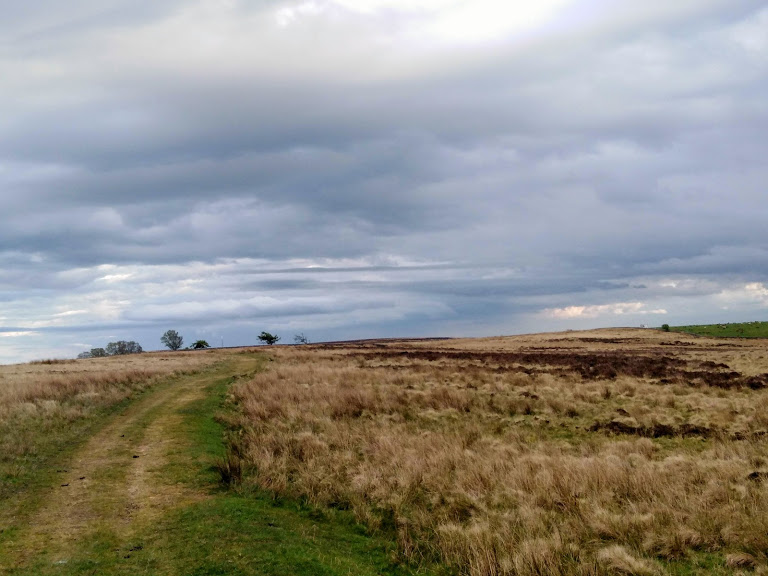
Yesterday, a still evening in early May, I set off onto the fell in search of skylark song. After weeks of strangely dry, sunny weather, the muddy track was baked to the consistency of cracked concrete, but on this particular evening the hills glowered under heavy grey rainclouds in the distance. There was a hint of thunder in the air. To the west, pale sunlight burst through the gloom in dramatic spotlights, illuminating the rim of Scotland far off on the horizon. Heading up the familiar track, I passed my neighbour herding sheep on his quadbike. With one arm round his small son and a loudly protesting lamb tucked firmly under the other, he looped around the field, gathering the sheep and channeling them through the gate, directing his dog with calls of “come by, Ben, come by”.
Passing onwards to the high point of the fell, the low groans of sheep and answering bleats of their lambs faded into the distance. Up here, there was no other sound but the faintest whisper of a breeze through the rough grasses, and the orchestra of bird song all around. There were no engines to be heard: no roar of aircraft heading towards the Atlantic from Newcastle Airport, no motorbikes blazing up and down the lanes of the North Tyne Valley far below, no distant cars. Even here, in one of the most sparsely populated parts of England, this total motor silence is unprecedented.
Instead, the tumbling song of the skylark rang out clearer and louder than ever. Surrounded by the cascading notes, punctuated every now and then by the peep-peep of a meadow pipit, the low drumming of snipe, or the burbling call of a curlew, I stood and drank it in.
As the coronavirus lockdown progresses, journalists have pointed out the silver linings of the worst global crisis since World War Two – for instance, skies clearing in the world’s most polluted cities and air quality soaring across the globe. In Punjab, India, residents are able to see the Himalayan Mountains for the first time in three decades. But in this remote corner of Northumberland, the silence of engines seems to me another small silver lining: the din of the world subsiding to allow the sounds of nature to ring out once more.
Perhaps the untainted song I heard that May evening is closer to what Vaughan Williams heard when he made his brilliant composition over a century ago – in another age, another crisis. Of course, the horrors of the First World War are a far cry from the very different crisis we are living through right now. But it is perhaps a small comfort to remember that no matter what storms humanity weathers, the skylark will keep on singing.
 Musings on Mountains